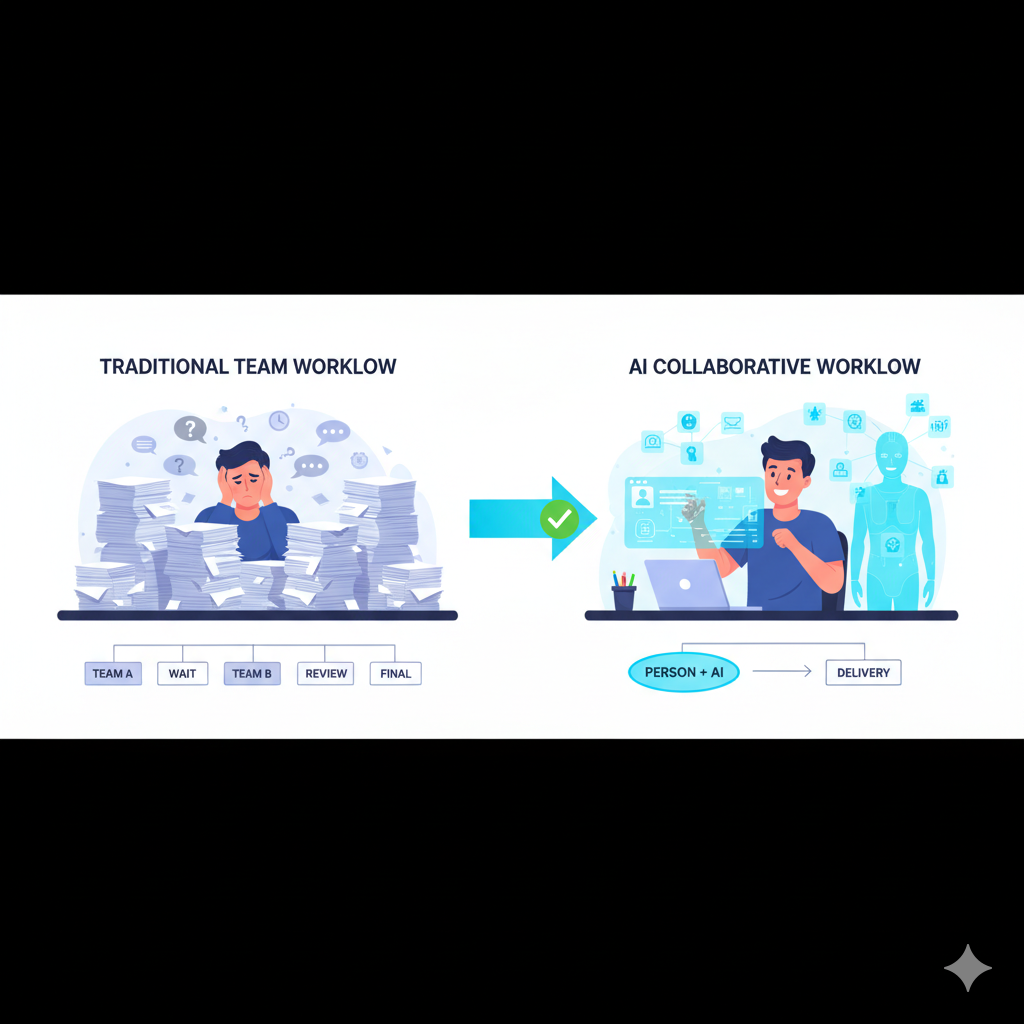
You have probably heard the catchy line already: AI will not replace you, but a person using AI will.
While popular, the real shift is more nuanced and commercially significant. The biggest change isn’t overnight job disappearance; it’s the expanding scope of what one capable person can achieve. When individual capacity grows, organisations fundamentally rethink how work gets done—altering headcount needs, specialist support requirements, and where they are willing to pay for deep expertise. Many teams are still underestimating this transformation.
Consider product management. Today, a strong product manager with AI support can handle far more surrounding tasks than businesses expected even a year ago. In a fraction of the time, they can summarise customer feedback, draft problem statements, structure discovery plans, pressure-test assumptions, create first-pass wireframes, and prepare stakeholder communications. Often, they can also interrogate product data, explore funnel performance, generate hypotheses, and sketch dashboards without waiting in a queue.
They haven’t magically become data analysts, designers, or engineers—they have simply become more self-sufficient, and this changes the economics of teams.
For years, knowledge work has relied heavily on handoffs: a question to the analyst, a concept to the designer, a summary to operations, or a slide deck to someone “more technical.” These handoffs aren’t free; they introduce delays, context-switching, and overhead. AI reduces these costs by empowering people to produce competent first-pass work independently. Consequently, the impact surfaces first in blurred role boundaries rather than sweeping org chart changes.
Business users are increasingly tackling work that once sat just outside their lane. The self-service analytics movement hinted at this before generative AI arrived, but the difference now is speed and range. Modern tools don’t just grant data access; they help users frame questions, identify patterns, build outputs, and communicate findings faster than ever.
This matters because organisations buy outcomes, not abstract capabilities. If a product manager can independently answer more questions, run experiments, and advance an idea further before needing specialist intervention, the business’s need for specialists shifts. They may not necessarily need fewer experts overall, but they definitely need fewer people performing routine support tasks. Value must now stem from deeper judgment, complex problem-solving, stronger governance, and work that genuinely requires deep expertise. Ultimately, AI doesn’t eliminate technical roles so much as it raises the bar for what those roles entail.
The same pattern is evident in analytics. Many analysts have spent years acting as a reporting service desk: pulling numbers, slicing segments, updating charts, and building dashboards. While some of this work remains, a growing share is easily handled by capable stakeholders when the underlying data foundations are solid.
As commercial leaders and operators self-serve their straightforward analysis, they stop needing day-to-day support. The most valuable analysts are now those who build trusted data products, solve messy cross-functional problems, and turn confusion into clarity—moving their work higher up the value chain.
This dynamic highlights why the lazy version of the AI debate misses the point. The question isn’t just whether AI can do your job; it’s whether a colleague can now absorb enough of your function to make your current role harder to justify at the same volume or level.
While less dramatic than mass-replacement headlines, this risk is far more realistic inside ordinary businesses. Most organisations won’t instantly delete entire departments because a model improved. Instead, they will gradually redesign workflows around individuals who can move faster with fewer dependencies.
This evolution brings two main consequences. First, professionals who master AI become immensely valuable by increasing their own leverage—writing, analysing, exploring, and unblocking themselves at unprecedented speeds. Second, those whose value relied primarily on executing routine support functions become highly exposed unless they pivot toward more strategic, technical, or judgment-heavy work.
There is no reason to panic, but every reason to be honest. The safest position is not to assume your job title protects you. Instead, strive to become the person who combines domain understanding, commercial judgment, and AI fluency better than anyone else. The true advantage lies not in AI replacing humans, but in AI-empowered humans expanding their useful output—forcing every organisation to rethink where specialist effort is truly needed.